How to Trade Gold Resistance Today: September 3, 2026
Learn how to trade gold's latest bounce from resistance with this simple, step-by-step strategy for beginners.
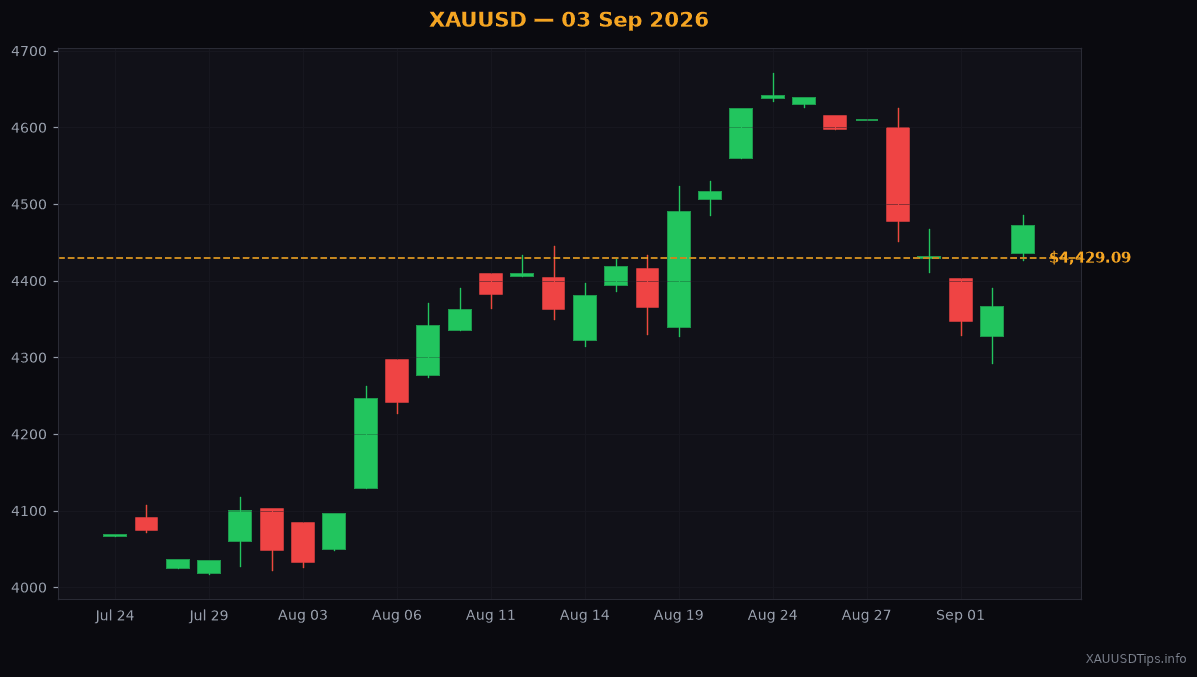
Hey there. Did you look at the charts today? It is September 3, 2026, and gold is on an absolute tear. The metal shot up by $105.60 today, landing right at $4429.09. If you live in India, Pakistan, or the UAE, you are probably hearing families groan about local jewellery prices. Buying physical gold in PKR or INR right now is incredibly expensive. But on the trading screens, this massive jump is creating a perfect setup for a classic strategy.
Today, we are going to look at a simple step-by-step method called trading the bounce. It is an ideal setup for beginners because it has very clear boundaries.
First, let's look at what is happening. Gold has jumped, but it is running straight into a major wall. We call this wall a resistance level. Think of resistance as a heavy wooden ceiling. The price can bounce up to it, but it struggles to break through. Today, that ceiling is a zone between $4,436 and $4,451.
Because the larger trend lately has been pointing down, many big sellers are waiting at this ceiling to start selling. This gives us an opportunity to try short selling. Short selling is when you sell first at a high price, hoping to buy it back cheaper later. You pocket the difference as profit.
Let us walk through the strategy step by step.
Step one is setting up your chart. You want to mark the resistance zone between $4,436 and $4,451. Draw two horizontal lines on your screen to create a visual ceiling.
Step two is waiting for a reaction. Do not just place a trade the second the price enters this zone. Watch how the price behaves. Do you see green candles starting to shrink? Do you see long tails on the top of the candles? This shows that buyers are getting tired.
Step three is entering the trade. Once you see the price struggle to push past $4,451, you enter a sell order. I think it is best to enter somewhere inside that $4,436 to $4,451 window.
Step four is setting your safety net. We call this a stop loss. A stop loss is an automatic order that shuts down your trade if the price moves too far against you. It protects your account from getting wiped out. For this trade, place your stop loss at $4,479. If the price climbs above that, it means the ceiling has broken, and we need to get out fast.
Step five is setting your target. This is your take profit level. A take profit is an automatic order that closes your trade once you hit a certain profit goal. Our first target is $4,367. If the price falls past that, the next target is $4,282.
What happens if the price breaks above our ceiling instead? If the price settles cleanly above $4,451, the downward trend is likely over. Buyers will take control, and we will have to change our plan. That is why we use a stop loss. No one wins every single trade. The secret is keeping your losses small when you are wrong, and your wins big when you are right.
This setup is clean because your potential loss is small compared to your potential reward. If you enter near $4,440, your risk to $4,479 is about 39 dollars. But your potential reward down to $4,367 is over 70 dollars. That is a great risk-to-reward ratio for a beginner.
Take your time, open a demo account, and watch how the price reacts to this ceiling today. Happy trading!
Written by XAUUSDTips Team. Not financial advice. Trade at your own risk. Technical levels partially referenced from LiteFinance analysts.
XAUUSDTips Editorial
Published September 3, 2026